Best Remote Control Car Circuits: Essential Kits and Modules for RC Enthusiasts
Answering your search for a reliable remote control car circuit, this guide highlights five practical options that suit different skill levels—from beginners building simple RC projects to students exploring advanced control systems. This selection helps hobbyists find components that fit common RC setups, such as high-power switches, 2.4 GHz modules, and STEM-friendly kits. Each entry notes who it’s best for and why it stands out, plus a quick buying table to compare key points at a glance.
| Product | Best For | Key Benefit |
|---|---|---|
| QOFOWIN Wireless Remote Switch | Builders needing high-current control | 328 ft range with 30A relay for DC motors and luminaires |
| MiOYOOW DIY Remote Control Car Kit | Students and beginners | Educational soldering practice and basic remote control car functions |
| 2.4G Four‑Channel Remote Module Set | DIY hobbyists | Four independent channels for multi-function RC projects |
| Self-Centering Steering RC Car | STEM learning for kids | Self-centering steering and drifting motion for engaging experiments |
| Snap Circuits R/C Snap Rover Kit | Classroom and home learning | Multiple rovers with wireless control and clear manual |
QOFOWIN Wireless Remote Switch With Long Range

This high-power remote switch uses a 30A relay to safely control DC motors, luminaires, and other electrical devices. Best for RC projects where a single receiver must handle a high-current load from a distance. The 433 MHz signal penetrates floors and doors, expanding usable range up to 328 feet. Choose this if your RC setup requires a robust, simple switch module without building a custom driver circuit. Limitation: installation assumes a static power source; switching heavy loads may require proper wiring and safety considerations.
MiOYOOW DIY Remote Control Car Kit
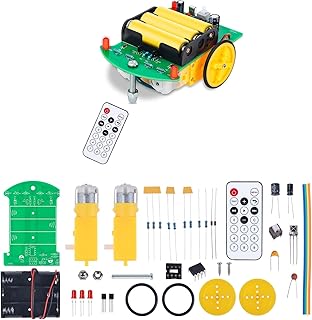
This STEM-focused kit doubles as a soldering practice project and a remote-controlled car. It’s ideal for students and beginners who want hands-on learning about mechanical motion, sensors, and basic electronics. Features include forward/backward, turning, stopping, and adjustable speed. The board shows clear signal reception indicators. Best for classrooms or home projects; caution: batteries are not included, so plan for power sources accordingly.
2.4G 4‑Channel Remote Module Set

This four-channel set provides a complete transmitter and receiver pair with a full module for immediate use in RC models and DIY projects. Its 2.4 GHz wireless connection is designed to minimize interference and maintain stable control even in crowded environments. Best for hobbyists who want separate channels for steering, throttle, lights, and additional functions. Choose this if you need reliable, multi-function control in a compact package; limitation: setup may require a basic understanding of wiring and channel mapping.
Self-Centering Steering RC Car

This STEM-focused RC car features drifting capabilities and a self-centering steering mechanism that returns to alignment after turns. It’s well suited for kids and beginners exploring vehicle dynamics and control systems. Best for hands-on experiments in classrooms or home projects where repetitive, predictable steering behavior supports learning. Caution: some assembly and soldering may be required depending on the model variant.
Snap Circuits R/C Snap Rover Kit

This educational kit lets users build and control a remote-control rover while exploring circuits, robotics, and motors. It’s ideal for classrooms or family learning, offering a hands-on approach to basic electronics and engineering concepts. Best for ages 8+ who want a guided, modular learning experience. Limitation: capacity to run multiple rovers at once may depend on the included controller setup and battery availability.
Buying Guide: Key Considerations for RC Circuit Choices
What power handling do you need? If you plan to drive larger DC motors, prioritize high-current switches or robust motor controllers. Consider the voltage range your RC system operates at and select components that match your power supply.
Which control method suits your project? RF modules, 2.4 GHz transceivers, and infrared options each have different range, interference resistance, and complexity. For multi-function builds, prefer multi-channel modules that offer independent control lines for steering, throttle, lights, and accessories.
Is this kit appropriate for your learner level? Educational kits and solder-practice modules are great for students and beginners; more advanced builders may prefer modular modules that require custom wiring and programming.
What about safety and ease of use? High-current components should be installed with proper wiring, heat management, and protective enclosures. Simple plug-and-play switches are convenient but may lack the flexibility of fully programmable controllers.
How scalable is the system? If you expect future upgrades, choose components from a compatible ecosystem with available add-ons and documentation, and note whether modules support expansion with extra channels or sensors.
FAQ
- What is the typical range for these RF remote systems? Most operate within a few dozen to a few hundred feet, depending on frequency, obstacles, and power.
- Do these kits require soldering? Some do, especially educational or DIY kits; others come preassembled for quick startup.
- Can I use multiple controllers with one receiver? Some 2.4 GHz sets support multiple channels, but check the product’s channel compatibility and pairing instructions.
- Are high-current relays safe for motors? Yes, when wired correctly with proper heat sinking and protection; always follow the manufacturer’s installation guidance.
- Which kit is best for classrooms? Kits with clear manuals, modular components, and classroom-friendly activities typically work best for learning environments.
- Can these modules be used for non-RC projects? Yes, many are general-purpose RC or automation modules suitable for DIY robotics and control experiments.