Best Timers for Kids: Visual and Easy-to-Use Time Timers for Learning
Answering the search intent for a timer that kids can understand, these visual, color-changing timers help children and caregivers manage time confidently. Each option is designed to be kid-friendly, with simple setup, clear visual cues, and safe operation. This guide highlights who each timer is best for and why it stands out, with practical considerations for home use, classrooms, and daily routines.
Summary of chosen products:
| Product | Best For | Key Benefit | Notable Limitation |
|---|---|---|---|
| Timer Pal Koala Visual Timer | Young children and families | Color-shifting, engaging visual timeline from blue to yellow to purple | Dial-based setup may take a moment for very young kids |
| 199 Min Visual Timer for Kids | Brush-time routines and short focus tasks | Long visual window with 2-minute brushing emphasis | Design is playful; may not suit all adults’ tastes |
| Yunbaoit Digital Visual Timer | Tech-savvy households; students | Digital countdown with a rechargeable option | Digital interface may require initial instruction |
| Digital Pomodoro Timer Cube | Study and classroom use | Preset intervals (5/10/25/50 min) for focused work | Primarily a classroom-style timer; less emphasis on kids’ color visuals |
| HIPPIH Visual Timer for Kids | Autism/ADHD-friendly settings | Silent and color-visual countdown with calm operation | Silence mode is best with minimal noise; some may prefer audible cues |
Timer Pal Koala Visual Timer for Kids

Best for families seeking a friendly, easy-to-understand timer. The Koala timer shifts colors as time passes—from blue to yellow at halfway, then to purple for the final 20%. When time runs out, a colorful glow lights up. The dial setup is simple: twist to set 1–99 minutes, press to start, and press again to turn off. It also offers a Companion Night Light mode for quiet evenings. Caution: the visual changes are the core feature; if a non-visual reminder is needed, combine with an audible cue.
Who it’s best for: young children learning to pace themselves, parents wanting a visual cue for transitions, and users who prefer a fun, non-verbal time indicator. Why selected: the engaging color progression and tactile dial provide an intuitive sense of elapsed time and pace for routines like chores, reading, or winding down before bed.
199 Min Visual Timer for Kids

Best for brushing routines and short focus tasks where a longer timer is not required. Visual cues emphasize the brushing window and task transitions, helping kids pace themselves. Caution: the design prioritizes visuals over a robust tactile interface, which may require parental help for younger children.
Yunbaoit Digital Visual Timer for Kids

Best for households that want a digital countdown with a long visual window and rechargeable use. The unit provides a clear numeric and color-based cue, which can aid those who respond to digital interfaces. Caution: initial setup may require guidance for younger children transitioning from analog to digital timers.
Digital Pomodoro Timer Cube

Best for study sessions and classroom use where fixed intervals foster focus. The cube offers preset windows (5/10/25/50 minutes) and a quiet, consistent countdown. Caution: it emphasizes productivity timing rather than a visual color narrative, so it may be less engaging for very young children who rely on color changes to gauge time.
HIPPIH Visual Timer for Kids
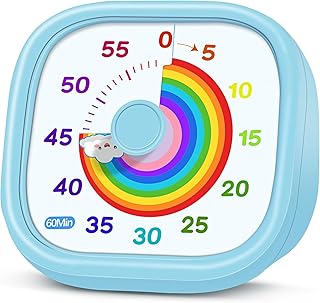
Best for calming routines and quiet transitions, especially for children with autism or ADHD. This timer features a lively rainbow visual and silent countdown when in specific modes. It’s easy to twist the knob to set time, and it can be silenced instantly with the rear switch. Caution: the primary appeal is visual; users seeking a loud reminder may prefer an additional audible cue.
Buying Guide: Timers For Kids
- Visual clarity: Choose timers that use color progression or large indicators so kids can understand time without reading numbers.
- Ease of use: Look for simple dials or push-button controls and quick startup sequences suitable for young learners.
- Sound options: Consider whether a silent or audible alert best fits the child’s needs and the home environment.
- Durability and safety: Prioritize child-friendly materials, rounded edges, and stable bases for desk or nightstand use.
- Task alignment: Match timer style to routines (homework, brushing, bedtime, chores) to reinforce positive habits.
- Portability: If you need timers on the go or in classrooms, check size and battery or USB charging options.
- Interactivity: Timers with shapes or characters can boost engagement; balance with plain timers for older kids who prefer minimal distractions.
Frequently Asked Questions
- What type of timer is best for younger kids? Visual timers with bright colors and a dial are typically easiest for toddlers and preschoolers to grasp.
- Do visual timers help with ADHD or autism? Many users report improved focus and smoother transitions when time is represented visually rather than verbally.
- Should I choose a timer with sound as well as visuals? If the environment requires reminders, an audible alert can complement the visual cue; otherwise, silent modes reduce distractions.
- Can these timers be used for adults too? Yes, the visual timers are helpful for achieving tasks and transitions for all ages, including adults in learning or therapy settings.
- Are these timers durable for daily use? Most designs are built for desk or bedside use; select models with sturdy housings and secure stands for frequent handling.
- What routines benefit most from visual timers? Brushing teeth, homework, bedtime routines, and task transitions are common uses where timing cues support consistency.