Best 18 Inch Training Wheels for Safe, Steady Riding on 18-Inch Bikes
If you’re seeking 18 inch training wheels, these options are designed to help young riders gain balance and confidence on standard 18-inch bikes. They’re best for first-time riders, families prioritizing stability, and parents aiming for a quiet, durable setup. Below, five top picks are summarized, followed by a detailed buying guide and quick FAQs to aid your decision.
| Product | Best For | Key Benefit |
|---|---|---|
| PRUNUS Flash Bike Training Wheels | Beginners on 18” bikes | Heavy-duty, compatible with multiple single-speed bikes |
| Bike Training Wheels for Kids Bike | Durability-focused riders | High-strength arm and reinforced construction |
| DDJKCZ Training Wheels | Budget-conscious families | Thick, upgraded, sturdy appearance with quiet operation |
| 2.0 – Training wheels for 14 16 18″ | Balance-focused learners | Training wheels that teach balance |
| RoyalBaby Training Wheels | Heavy-duty, quiet rides | Steel brackets, quiet tires, adjustable height |
PRUNUS Flash Bike Training Wheels for 12 14 16 18 20 In Single-Speed Bicycles

- Heavy-duty design that fits multiple single-speed bikes, including 18 inch wheels.
- Durable arm construction designed for stability and long-term use.
- Simple installation with straightforward compatibility notes.
Best for: Parents seeking a robust, wide-compatibility option. Why: Its heavy-duty build supports repeated use and rough urban surfaces. Limitation: Check axle compatibility before installation to ensure proper fit on your bike.
Bike Training Wheels for Kids Bike, High-Strength Arm, Reinforced

- High-strength arm and reinforced construction for longer life on 18″ bikes.
- Upgraded durability with easy install guidance for parents.
- Rear axle check recommended before purchase to ensure compatibility.
Best for: Families prioritizing durability and easy setup. Why: Reinforced components reduce wobble during early rides. Caution: Verify rear axle compatibility prior to buying to avoid mismatch.
DDJKCZ Training Wheels, Compatible for Bikes of 12 14 16 18 20 Inch
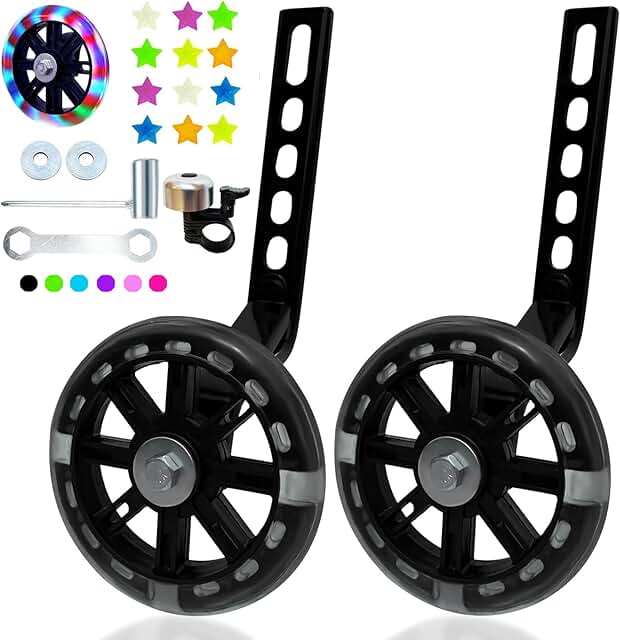
- Thick, newly upgraded design with a sturdy appearance and Flash Mute Wheel.
- Compatible across a wide range of wheel sizes, including 18 inch.
- Quiet operation and durable materials for steady rides.
Best for: Parents wanting a versatile, all-in-one trainer wheel set. Why: The broad compatibility helps future-proof purchases. Limitation: While durable, ensure the mounting hardware matches your bike’s frame.
2.0 – Training wheels for 14 16 18″ kids bikes
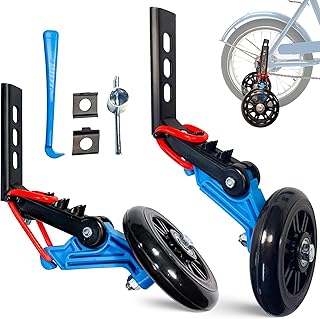
- Balanced design aimed at teaching balance progressively.
- Suitable for 14, 16, and 18-inch kids bikes with clear installation steps.
- Clear instructions help reduce setup time for new riders.
Best for: Beginners focusing on gradual balance development. Why: Designed to ease kids into balancing without abrupt transitions. Caution: May require adjustment as your child grows to larger wheel sizes.
RoyalBaby Training Wheels for 16, 18 Inch Kids’ Bikes

- Heavy-duty steel brackets paired with quiet rubber tires.
- Adjustable height to grow with your child’s riding ability.
- Designed for quiet operation and stable rides on 18-inch bikes.
Best for: Families seeking a sturdy, adjustable trainer wheel set. Why: Steel brackets and quiet tires offer reliable stability. Limitation: May be slightly heavier than plastic-bracket alternatives, affecting initial setup time.
Buying Guide: Key Considerations For 18 Inch Training Wheels
- Bike compatibility: Confirm wheel size (18″), axle type, and frame clearance before buying.
- Durability vs. cost: Heavier-duty arms and steel brackets last longer but may cost more upfront. Match to riding frequency and terrain.
- Installation ease: Look for clear instructions, universal brackets, and compatibility with common rear axles.
- Wheel alignment: Ensure symmetric wheel placement to prevent pull to one side and ensure stable starts and stops.
- Adjustability: Choose models with adjustable height or angle to adapt as your child grows or gains balance.
- Noise and friction: Quiet tires and well-sealed bearings reduce squeaks and drag, improving confidence during early rides.
- Weight: Lighter units are easier for parents to install and for kids to feel during initial rides.
- Warranty and service: Consider brands offering replacement parts or simple maintenance steps.
FAQ: Quick Answers For 18 Inch Training Wheels
- What age is best for 18 inch training wheels?
Typically suitable for kids transitioning from smaller bikes who ride on 18-inch wheels. - How do I know if they fit my bike?
Check wheel size, axle type, frame clearance, and the manufacturer’s compatibility notes. - Are training wheels good for beginners?
Yes. They provide stability as riders learn balance and steering control. - Should I choose steel or plastic brackets?
Steel brackets are generally more durable; plastic may be lighter but less robust over time. - Can training wheels be adjusted as my child grows?
Many models offer height adjustments to accommodate growth and skill progression. - When should training wheels be removed?
When your child consistently maintains balance and straight-line riding without support.